Most companies that come to us for cleaning will usually have a specific cleaning standard they are looking to achieve. Some of these standards are historic, set up when the parts were first designed. One we were asked to clean to was from 1983!
The standards we have asked to follow range from MOD Defence standards to aerospace to ISO standards relating to specific industries. We have successfully cleaned to all these.
Can you certify your cleans?
Yes and no. We do not have all the equipment at our site to do these sort of tests as it requires a variety of specialised instruments often working in a cleanroom environment which we do not have. We approach the validation process by performing a clean on parts which can be then sent off for testing by a third party or the customer themselves. When these parts meet the required cleaning standard or specification, we then certify the cleaning process we used. In fact, this approach is the same one used by most MOD specifications which detail the cleaning process to be followed that results in the desired level of cleanliness.
We then work to these standard defined procedures on all future jobs and provide a certificate of conformance to guarantee the parts were cleaned using the approved process. Our ISO:9000:2015 quality assurance certification acts as the validation of our internal systems that support this process.
We have done this for companies in the defence, oil and gas, aviation, pharmaceutical, and medical industries with no issues over the last 15 years.
Can Sonic Solutions help us define our own cleaning standards?
Of course! Sometimes a customer may not themselves be able to strictly define the cleanliness standard they require. In this situation, we have reverse-engineered the cleaning process to arrive at their required standard. We have cleaned sample batches of parts to different levels of cleanliness. We then send them off for testing (or the customer tests them in-house) and the customer establishes the “pass” level of cleanliness. We can then define the process used to achieve that level and certify all future cleans to guarantee they have been through the set process to achieve that desired level of cleanliness. It is a classic case of designing the quality/cleanliness level into the process adopted rather than testing the quality in, resulting in greater confidence levels of the quality achieved together with lower costs of achieving it.
To understand more about ultrasonic cleaning and how it might benefit you and your application please call or email one of our helpful cleaning experts today on 01924 938052 or hello@sonicsolutionsltd.com

In many businesses, cleaning is not given much thought, until the item becomes too dirty to work effectively. At this point, the part can either be replaced with a new one or cleaned. This cleaning, if done properly, will prolong the part’s life for a period, maybe even indefinitely.
However, for certain types of items, running them until they no longer work can lead to irreversible damage such that they can only be cleaned so many times before requiring replacement. This is when a proactive cleaning schedule should be considered. The frequency of this planned cleaning will depend on the needs of the business and type of item.
Benefits of Proactive planned cleaning
There are many other benefits to a planned cleaning schedule. Down-time can be kept to a minimum as you can choose the most convenient time to service your parts rather than having a stoppage when they fail. There can also be cost savings on the cleaning itself as a partially contaminated item will clean quicker, easier and cheaper than a completely contaminated one. Sonic offer preferential pricing for those who send items in regularly for cleaning.
The process that the part serves also invariably works better – quicker, less downtime, less waste, better end product, and easier running.
Finally, when cleans are planned we can offer a quicker turnaround since your part is booked into our work schedule with the necessary equipment, chemical and staff in place.
Typical items benefiting from a proactive approach
Items like filters, flame arrestors, print rollers, heat exchangers and valves are all likely to offer significant advantages when cleaned proactively with a planned schedule. They will last longer, function better and cost less time and money.
To understand more about ultrasonic cleaning and how it might benefit you and your application please call or email one of our helpful cleaning experts today on 01924 938052 or hello@sonicsolutionsltd.com
How close to God are you?! An introduction to Cleanliness Standards.
We are in the business of cleaning and a common question we get asked is “how clean we can get their parts.” Wrong question! The question we need to answer is “how clean do we need it ?”
The level of cleanliness required is always determined by the requirements of the next stage of the process that the object being cleaned will go through. It is never about how clean we can get an item, but how clean the item needs to be in order to be fit for purpose. It is always objective and specific.
Definition – Any level of cleanliness is measured and defined, not by the absence of contaminant, since complete absence of anything is both impossible and immeasurable. Rather it is stated as the maximum permitted level of a given contaminant(s). That is, as an amount of contaminant(s) in a given area, volume or on the surfaces of the component to be cleaned.
There are 2 basic approaches to defining the required level of cleanliness;
- Stating the maximum number of permitted contaminants of various sizes in a given volume or surface area (ISO standards, and previously National Aerospace Codes (NAS) took this approach);
- Defining a cleaning process which, if followed, will result in achieving the desired level of cleanliness (Ministry of Defence (DEF) standards often follow this approach).
The International Organisation for Standardisation (ISO) Have issued a multitude of standards relating to cleanliness in various applications and industries. One of the most popular is ISO 4402, and the table below gives the ISO code relating to the maximum number of particles of various sizes permitted. The lower the code higher the level of cleanliness, hence the lower volume and size of permitted particulate contaminant. Manufacturers of specific items such as hydraulic filters and oils will specify the cleanliness code associated with, and required by, their product for its efficient performance.
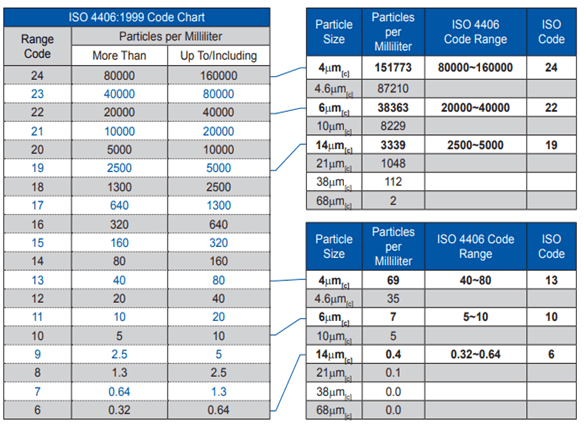
Sometimes a cleanliness standard applying to one area can become a surrogate for another. For instance a hydraulic oil manufacturer that gives an ISO 4406 code for its oil, by inference, defines the cleanliness code for a filter used in such systems. Helpfully leading companies in the sector, such as Parker Hannifin, issue tables of recommended ISO codes numbers for different types of systems, components and sensitivities, which I reproduce below;
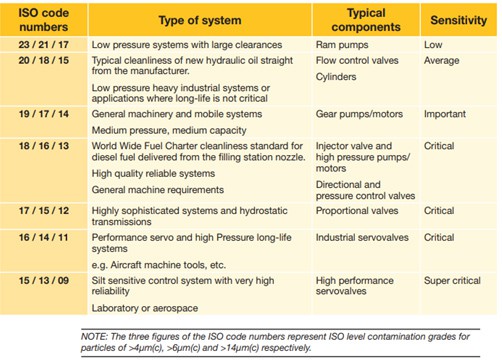
Whilst specific and objective, these standards have 2 major shortcomings;
- They do not tell you how to clean an item to achieve this level of cleanliness;
- Actual measurement of cleanliness is a complex and expensive exercise, often beyond the capabilities of the manufacturers, particularly on an ongoing basis.
The Ministry of Defence MOD or DEF standards adopted a different approach that overcame these issues, by defining a process that would achieve the levels of cleanliness required in a specific situation.
They cover a variety of different processes and systems including; clean rooms; the handling and installing of non-volatile residue sample planes in environmentally controlled areas (e.g. in spacecraft); standard test methods for determining cleanliness levels; aerospace fluids; pressurised gas analysis; gas blown down systems and non-volatile residue of halogenated solvent extract from aerospace components.
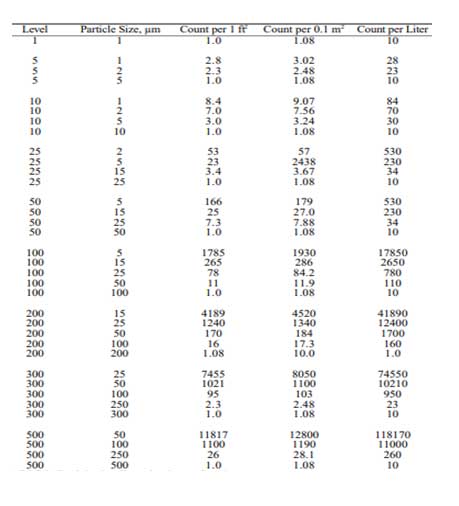
As shown in the figure below, the standards involving particulate cleanliness levels have a set of levels from 1 to 1000. Each level has a set of particle sizes (a different set for each level) with a maximum particle count per foot squared, per meter squared and per litre. Thus, these standards can be used for classifying the cleanliness of both surfaces and fluids. For simplicity, we show only levels 1 to 500 here.
The MOD standards also address the measurement of cleanliness. The methods proposed for the testing of cleanliness include
- Direct measurements – analysis of part of the surface, liquid or gas of interest;
- Extractive sampling – extracting a small sample of the material of interest for testing, this is the most widely used approach for NVR or particle cleanliness determination) and…
Indirect sampling – testing a sample whose conditions reflect that of the material of interest. This is the least accurate of the three methods but must by necessity be used when the material of interest is inaccessible.
The actual method of testing, sampling and measurement of cleanliness within the standards is done using a variety of methods, which we will address in a future blog.
To understand more about ultrasonic cleaning and how it might benefit you and your application please call or email one of our helpful cleaning experts today on 01924 938052 or hello@sonicsolutionsltd.com
We certainly live in interesting times and while this crisis will pass, we don’t know when and it’s unlikely we will return to how it was before. So how do we respond to these uncertainties? I am a member of a number of organisations that are very clear on what businesses should be doing in these times. And they all identify three key elements to what we should be doing to survive this crisis and come out the other end. Protect, Plan and Prepare.
PROTECT
We’ve got to protect ourselves and our families to ensure that we are in a fit state to do things. not just physically but mentally. We’ve got to focus on being a force for good, for our own sake and for others. Those who act purely with selfish aims and motives will be remembered! We must also protect our staff making sure that they too are fit both physically and mentally to survive and then re-enter the business when this is over.
Then we must protect our business making sure that we take full advantage of all the assistance the government and others are offering. Our businesses must survive. And cash flow is fundamental to this.
And we’ve got to protect our customers. We must communicate what we’re doing, what we’re not doing, and that we are still there to serve them even if it’s not in the same way.
In my case I am sticking by the government guidelines on just having contact with my own household, washing hands and surfaces regularly and avoiding social contact. Obvious things, simple things, but not necessarily easy to do day in day out! We are operating a rota system keeping open normal hours but with a skeleton workforce to handle essential jobs without coming into direct contact with each other and others. This rota is based on 3 week alternating periods for all employees so that we can still claim the 80% Corona Job Retention Scheme (CJRS) wages grant. It also means all employees are being treated equally and are still involved in the business. We have set up a WhatsApp group for all staff to let everyone know what is happening, and set training and learning objectives whilst they are on furlough. I’m trying to communicate all of this to my customers through social media and direct emails to let them know that we’re open to handle their critical jobs.
PLAN
We must plan those for what we do during this situation and what we do when we come out of it. The good news is that most of us actually have more time to do this now. The bad news is that I’m convinced that more businesses than people will die during this period. So what planning? Whatever business we’re in, we need customers and those customers need to know what we’re going to do for them. So we need to plan what we’re going to tell them and how we’re going to tell them. We cannot be invisible to our customers and we’ve got to address their real needs, talk about their worries and concerns, give them useful and interesting information (particularly how it addresses their worries and concerns ), and tell them how we can help them solve their worries and concerns. This is how we add value; this is how we serve them best.
So in my own business we are going through all customer and enquiry lists, making sure they are accurate and complete. We are preparing information explaining what we do to solve their problems, making videos, blogs, podcasts and website posts. We are then posting this out on social media and our website. We’re calling customers to see how they are and if there’s anything we can do to help. Not just work for them, but any problems they’ve got including practical ones like payment terms where we are offering extended credit. We are also studying and developing new skills (zoom, video editing etc..), researching new industries and topics, making contact with new people. I’m finding that a lot of people have more time now to actually discuss problems and opportunities. We may not be able to do much, to physically see and meet them, but we can talk to them, and send information to them, preparing the ground for when this is over and we can hit it running.
Apparently the Chinese word for crisis is a combination of the two words danger and opportunity. And when we come out of this crisis there will be opportunities for those well prepared for them and have planned for them. I’m trying to make sure we are able to take advantage of these opportunities when we emerge from this situation.
PREPARE
This crisis will pass. Our Freedom Day will come and when that does happen we can either step back through fear or we can step forward into growth. I don’t believe we will go back to how we were before this, and those that try will suffer.
When it does end, it will end quickly and we must be prepared to act equally quickly. This means being in a position to serve our customers. maybe even in ways that we haven’t served them before. Communicating by video for example, or having new products and services to offer.
One thing we do know is that we will never have another time when we’ve got so much time to do the things we never had time for before! We must use this time properly to set up communications with our customers, get our marketing systems set up and ready to implement and create compelling messages as to how we can help our customers. Together with the capability to actually deliver on our promises then I believe we will not just survive but thrive when this current situation comes to an end.
So in Sonic we’re working to make sure our channels of communication are properly set up, that we have good and relevant messages to send, and that my team have all the tools and are ready to deliver the services and products we will be offering. I’m developing new relationships with both potential suppliers and customers and made sure finances are in place to support the business.
Nothing in life is guaranteed but we are all responsible, individually and collectively, to manage this situation as best we can. Our attitude and actions will determine our outcome.
I hope this was helpful. I’m not pretending I’m getting everything right, or that this is all my own ideas, but the people I have seen following these processes and actions are those that I’m sure will come through best.
Anything I can do to help just ask.
Take care to survive; prepare to thrive.

Why we offer them
- So you the potential customer can see with your own eyes the cleaning standards we achieve and whether it meets your requirements
- So we define the cleaning process required such that
- It is repeatable
- We know how to price it
- Whether it is the cleaning service, the cleaning chemical, or the cleaning equipment we are looking at, there is now a firm foundation and certainty about what we need to offer and what you can expect.
What we offer
- For items we have not cleaned before we will clean free of charge a representative sample, or samples, of the item to be cleaned. You will ship it to us and we will ship it back. Sometimes we will take a few samples to enable us to conduct extensive trials. This will be discussed and agreed at the outset.
- We will then conduct trial cleans of the samples to establish the full cleaning process required, including pre-treat, chemical wash, rinses, drying, inspection and packaging for dispatch.
- With our experience, we usually establish the full cleaning process quite quickly, but optimising it may take some more time. Timeframes of up to a week are normal, although some may take longer.
Like ingredients in a cake, the various steps in the cleaning process are all necessary to guarantee the desired outcome consistently. frequently we see the right chemicals and the right equipment being used but not resulting in the right outcome consistently. Missing, or badly executed steps, and untrained personnel are the usual reasons for this.
Conclusion
Trials guarantee the desired outcome for both of us, which is why we offer them. We regard their cost as an investment in our future relationship, well worth the price. And for you it is a risk-free guarantee of the outcome, a certain solution to your dirt problem.
To understand more about ultraosnic cleaning machines and how they might benefit you and your application please call or email one of our helpful cleanign experts today on 01924 938052 or hello@sonicsolutionsltd.com

When the government advised a nationwide shutdown for all non-essential workers we did wonder if our cleaning was essential or not. We knew that parts we cleaned were vital to essential industries like power generation and pharmaceutical so after some thought, we decided to scale back and introduce work practices that minimised our social contact.
A week in and it is becoming even more apparent to us that some of the industries we serve are directly involved in the fight against Corona. We have just learned that this week we shall be cleaning O-Rings needed in the production of emergency respiratory units used to treat people suffering from Covid-19. Two pharmaceutical companies that we clean filters for increased their orders with us. Power stations are sending filters for the oil that lubricates their turbines and even a defence equipment manufacturer got in touch to make sure that we were still open for an emergency parts clean.
We’re not on the frontline of this crisis, and we’re not putting ourselves in any real danger but we are proud to be doing our bit to help the essential workers and businesses during these uncertain times.
We will continue to remain available for essential jobs required by our customers and we will keep going until this is all over. Just as important we will be here beyond this crisis for when things return to normal… whatever that normal turns out to be. And we will do everything in our power to help our customers get through this as well.
We are very much in this together. We’re happy to do vital work, we’re happy to defer payment where necessary, and we are always available to answer any questions, enquiries or requests for help you have. Just call us on 01924 938052 or hello@sonicsolutionsltd.com